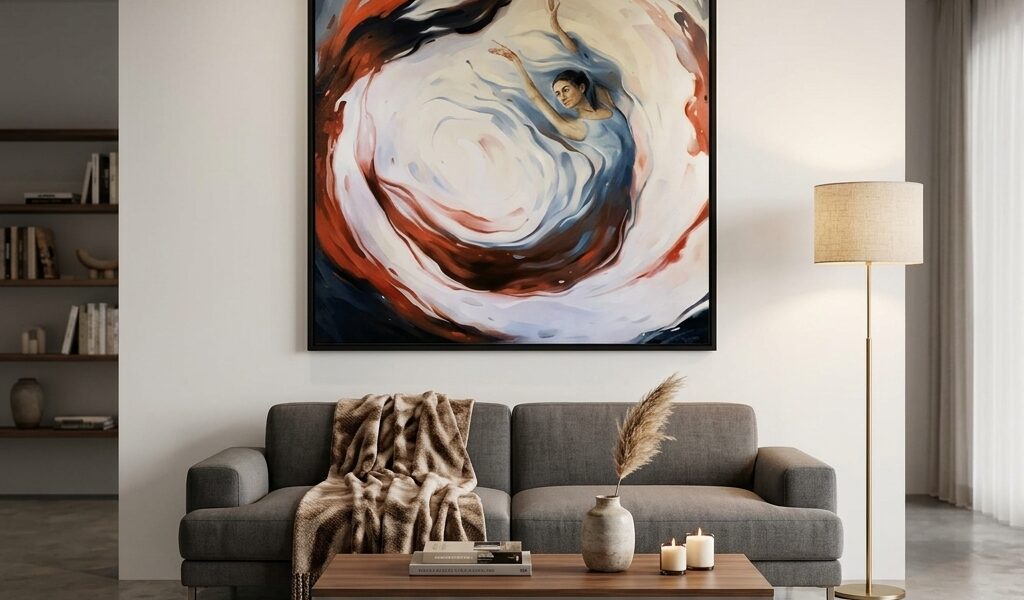
Art in the interior — more than decoration
A painting on the wall is not just a decorative element but an expression of the personality of the people who live there and a way to create a unique atmosphere. Properly hung art can completely change the character of a room, giving it depth and bringing harmony. Yet many of us face the same dilemma: how should a painting be hung so that it looks professional and delights the eye for years?
In this guide you will find practical tips to help you create the arrangement of your dreams — whether you are planning to hang one large painting or a whole gallery of works.
The ideal hanging height
The most common mistake when hanging paintings is placing them too high. Professionals follow a simple rule: the centre of the painting should be at eye level, i.e. around 145-150 cm from the floor. This is the standard height used in art galleries all over the world.
Exceptions to the rule
- Above furniture: if you are hanging a painting above a sofa, chest of drawers or bed, leave 15-25 cm between the furniture and the bottom edge of the painting
- In the dining room: a painting above the table can hang slightly lower, especially if it will mostly be viewed while seated
- On a staircase: keep the centre of the painting at a constant height relative to the stairs, not the floor
- In a child’s room: adjust the height to the child’s eye level
Fixing methods — safe and secure
The right hanging method depends on the weight of the painting and the type of wall. Here are the most commonly used solutions:
Light paintings (up to 5 kg)
Standard self-adhesive hooks or small picture nails will be enough. This is the ideal solution for works on paper or small canvases. Make sure, however, that the wall is clean and dry before you stick the hooks on.
Medium paintings (5-15 kg)
Use wall plugs with hooks or screws driven directly into the wall. For paintings on canvas — such as the magical realism of Magdalena Dziejma — this is the safest solution.
Heavy paintings (over 15 kg)
These require sturdy wall plugs, ideally with two fixing points. It is worth locating the wall studs or using special anchors for plasterboard.
Lighting a painting — how to bring out the details
Even the most beautiful painting may not look its best in poor lighting. Light should enhance the qualities of the work without creating glare or distorting its colours.
Natural light
Avoid direct sunlight, which can cause the paint to fade over time. If the painting hangs opposite a window, consider using blinds or curtains during the sunniest hours.
Artificial lighting
- Picture lights: mounted above the frame, they light the surface evenly without reflections
- Spotlights: fitted in the ceiling and angled at 30 degrees to the surface of the painting
- Diffused light: floor or wall lamps create a subtle atmosphere
Choose bulbs with a colour temperature of 2700-3000K (warm white), which do not distort colours and create a cosy ambience.
Composing a gallery wall
If you own several works, you can create a striking gallery wall. Here are some tried-and-tested layouts:
Symmetrical layout
Paintings of the same size hung in a regular grid — an elegant, classic solution that is ideal for minimalist interiors.
Central layout
One larger central painting surrounded by smaller works. This composition has a clearly defined focal point that draws the eye.
Organic layout
A free arrangement of paintings of different sizes — first lay out the composition on the floor, take a photo, then reproduce it on the wall. This is the best method for eclectic interiors.
Matching the painting to the style of the interior
A painting should complement the character of the room, but it does not have to match its colours perfectly. Sometimes contrast works in the arrangement’s favour.
Minimalist interiors
Choose works with a clean composition and a subdued palette. Large formats work better than many small pieces.
Classic interiors
Paintings in ornate frames, oil paintings, landscapes — all of these go beautifully with traditional furniture.
Modern interiors
Contemporary art, abstraction, magical realism. Works such as “Intraverse 4” by Magdalena Dziejma introduce an element of surprise and reflection — ideal for living rooms with a modern finish.
Common mistakes when hanging paintings
- Too high: a painting should not “escape” towards the ceiling
- Too much on one wall: breathing space between works is just as important as the paintings themselves
- Ignoring proportions: a small picture gets lost on a large wall, while a large one overwhelms a small room
- Lack of cohesion: if you hang several works, find a common denominator — subject, colour scheme or frame style
- Neglecting the level: use a spirit level — even a slight tilt catches the eye
Practical tools to make the job easier
Before you start hanging, get ready:
- A spirit level (or a smartphone app)
- A tape measure or folding rule
- A pencil for marking points
- Suitable hooks or wall plugs
- A drill (for heavier paintings)
- A metal and cable detector (if you are drilling into the wall)
Summary — art in your home
Hanging paintings is an art in itself, but with a little planning and an awareness of the basic rules, anyone can create a professional-looking arrangement. Remember: a painting is an emotional and aesthetic investment for years to come, so it is worth taking the time to hang it properly.
Looking for an exceptional work for your interior? Discover the work of contemporary Polish artists such as Magdalena Dziejma from Białystok, whose paintings combine magical realism with a profound philosophical message. Original paintings in oil and acrylic on canvas will bring a unique atmosphere into your home and become the centrepiece of any arrangement.